

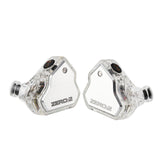
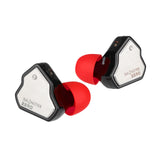
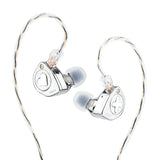
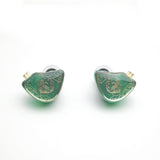
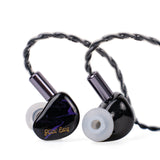
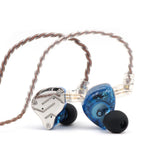

Different drivers.
Your kind of sound.
Understand what moves the music. Explore the construction behind each driver, then choose products by the sound, fit and listening experience you prefer.
Every technology.
One clear comparison.
Compare driver benefits, typical frequency roles and starting products. Select a technology to see how it works. Choose Headphones to see only technologies with matching products.
| TechnologyHow it creates sound | Design advantagesPotential benefits, plus what to check | Typical frequency roleImplementation, not a response graph | Your starting pointLowest in-stock complete-product price |
|---|---|---|---|
|
DD Read guide |
|
Full-range, or bass in hybrids BassMidsTreble A dynamic driver can handle the whole mix. Multi-driver IEMs often assign it the lows. |
Loading current prices…
Read guide
|
|
BA Read guide |
|
Band-specific or full-range BassMidsTreble The chosen receiver determines its job. All-BA arrays can cover bass through treble. |
Loading current prices…
Read guide
|
|
PM Read guide |
|
Full-range, or a specialist band BassMidsTreble A full-size planar can cover the whole spectrum. A smaller element may serve only part of a hybrid. |
Loading current prices…
Read guide
|
|
EST Read guide |
|
Treble / ultra-treble in IEMs BassMidsTreble Commonly used as a tweeter in multi-driver IEMs. Full-size electrostatic headphones are a different system. |
Loading current prices…
Read guide
|
|
MPT Read guide |
|
Upper frequencies in hybrids BassMidsTreble Designed here as an upper-range ingredient rather than the entire earphone. |
Loading current prices…
Read guide
|
|
PZT Read guide |
|
Often upper treble in IEM hybrids BassMidsTreble A common high-frequency supplement. Some designs couple the same component mechanically. |
Loading current prices…
Read guide
|
|
BC Read guide |
|
Varies with the implementation BassMidsTreble Not inherently a bass-only technology. Driver actuation and contact design determine its contribution. |
Loading current prices…
Read guide
|
|
MEMS Read guide |
|
Full-range or a tweeter role BassMidsTreble The MEMS label describes scale/manufacturing, not one fixed bandwidth or sound. |
Loading current prices…
Read guide
|
|
AMT Read guide |
|
Full-range in current earphones and headphones BassMidsTreble Known for tweeter use in loudspeakers, but not restricted to treble in these earphones and headphones. |
Loading current prices…
Read guide
|
Choose another product format to explore the available technologies.
Technology is not
driver count.
Read the construction and the configuration together. A shared label does not tell you how every band is handled or how the finished product is tuned.
-
Single Driver
One active driver per side. This is not the same as one technology spread across several drivers.
For example-
MOONDROP CHU III
$24.99 USD View -
KEFINE Loric
From $29.99 USD View -
7Hz x Crinacle: Divine
$159.00 USD View
-
-
One technology, several drivers
An all-BA array can use multiple drivers and still belong to a single technology family.
For example-
KZ Sonata X
$179.99 USD View -
Kiwi Ears Orchestra II
From $349.00 USD View -
DUNU Kaoru
$1,699.00 USD View
-
-
Hybrid
Two technology families in one earpiece, most often a dynamic driver for bass with balanced armatures or a planar above it.
For example-
ZiiGaat x Fresh Reviews Arete
$249.00 USD View -
XENNS Mangird Tea PRO
$359.00 USD View -
Kiwi Ears Canta
$89.00 USD View
-
-
Tribrid
Three technology families, such as dynamic, balanced armature and electrostatic. The product specification gives the actual driver count.
For example-
SIMGOT EW300
From $79.99 USD View -
Punch Audio Martilo
$329.00 USD View -
Kiwi Ears x HBB Punch
$449.00 USD View
-
-
Quadbrid
Four technology families in one shell, for example dynamic, balanced armature, planar and piezoelectric.
For example-
SIMGOT SuperMix 4
$169.99 USD View -
Kiwi Ears Septet
$269.00 USD View -
SIMGOT SuperMix 5
$219.99 USD View
-
-
Not every tag is another driver
Piezoelectric and bone conduction can describe one physical component. Do not add tags together to calculate driver count.
For example-
TANGZU TianPeng
$629.00 USD View -
Unique Melody Multiverse Mentor
From $4,499.00 USD View
-